Friday, January 20, 2023

The Best Advice: CALM DOWN PATSY


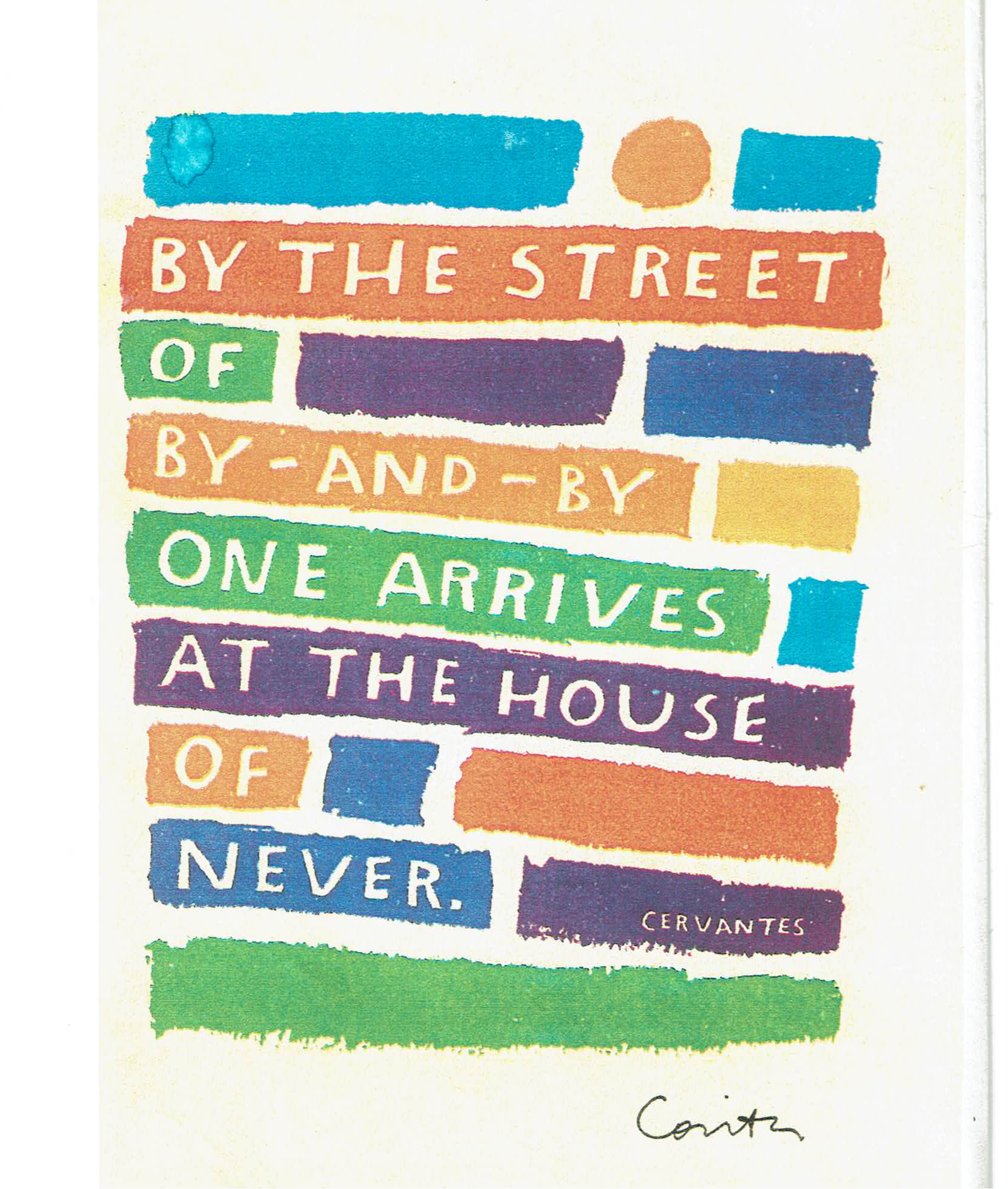
FROM MY MOTHER: Mom had a small 4” x 6” picture frame that contained a colored poster with the words “By the street of by-and-by one arrives at the house of never.” After mom's death, I got the framed poster and for years it had a prominent place among family pictures on a shelf in my house.

 These were words Mom and I took to heart and most times whatever we were thinking of doing, we would “Do it now” and not procrastinate. Good advice for me for many years.

But... now that I'm old and tired more often, I'm OK with putting things off. And sometimes I get to them and other times not. This is true even though I know my days are numbered and I know that if I don't do :whatever" now, it may never get done. I'm OK with that too.

FROM MY FATHER: Dad carried a small silver triangle with the words “This too shall pass” in his pocket for as long as I could remember. I don’t know what happened to the pocket piece but during his life, Dad showed it to me frequently.

These were not words for me to live by. Not at all. Never. I was born in 1944 and all my thinking life I knew about the Holocaust and about the Jews and others who were rounded up by Nazis and Jew-haters and for them the horrors would not pass. Their inevitable end was death.

 So much for Dad’s advice.

 However, I recently heard a Rabbi tell this story that involved Dad’s favorite saying. 

A powerful king asks his assembled wise men to find something that will make a happy person sad and a sad person happy. The wise men traveled the country far and wide. Finally, one came upon a peasant who told him to return to the king with these few words: “This too shall pass,” meaning when you are feeling happy or experiencing happy times, know it won’t last, and conversely when you are feeling sad or experiencing sad times know that also won’t last.

 “This too shall pass” is true under normal circumstances. But under major terrible irreversible circumstances, these words were and still are useless as words to live by.

Curiously Mom and Dad's favorite words to live by are opposite. From Dad, "Just wait it out, whatever bad circumstances happen. Things will change." From Mom, "Get going. Time is passing. Don't wait. If you don't do it now, you may never do it and you'll be sorry." But most curious of all, the best advice for me today came from an unusual source many years ago.


THE BEST ADVICE  
FROM 4-YEAR-OLD MARGRETTA

About forty years ago, my partner Cheryl and I were at dinner at the home of friends who had a four-year-old daughter named Margretta. 

The conversation was lively. All four of us were talking about this and that and suddenly Margretta interrupted us saying loudly and as forcefully as an insistent four-year-old can “CALM DOWN PATSY!” We looked at her and looked at each other and didn’t understand what she meant, so we continued talking. Again, Margretta said even more loudly “CALM DOWN PATSY!!” This time we stopped talking and all of a sudden it came to me that she was addressing me, meaning to say to me: “CALM DOWN BETSY!”

 I have been known to talk loudly and insistently and must have been annoying Margretta big time. I shared my insight with Cheryl and Margretta’s parents and we had a good laugh. Over the years I’ve told this story many times.

 But why, you might ask, today would I identify Margretta’s directive from so many years ago as the best advice? Today at age 78, if I do things that take too much energy, if I walk too fast for example, or try to do too many things at once, or maybe get too excited about this or that, I get out of breath and my heart feels like it is beating too hard. When this happens, I say to myself “Calm down Patsy” which amuses me greatly and reminds me that I must slow down and remember to breath. 

If I can, I will stop what I'm doing and sit down for a while and breathe, just breathe until I -- “PATSY” -- am able to calm down and resume what I was doing at a more reasonable pace. And I send thankful thoughts to forty-plus year old Margretta wherever she may be.


Saturday, April 9, 2022

Twists and Turns: War Postcards from My Spanish pen-pal (excerpt from book)

My correspondence (since 1931) with my Spanish pen-pal Jesus was interrupted by the Spanish Civil War which started in July 1936. Though there were no letters from Jesus that year, I continued to write to him infrequently. I hoped to hear back even though I understood that the war slowed down (or stopped) mail between America and Spain.

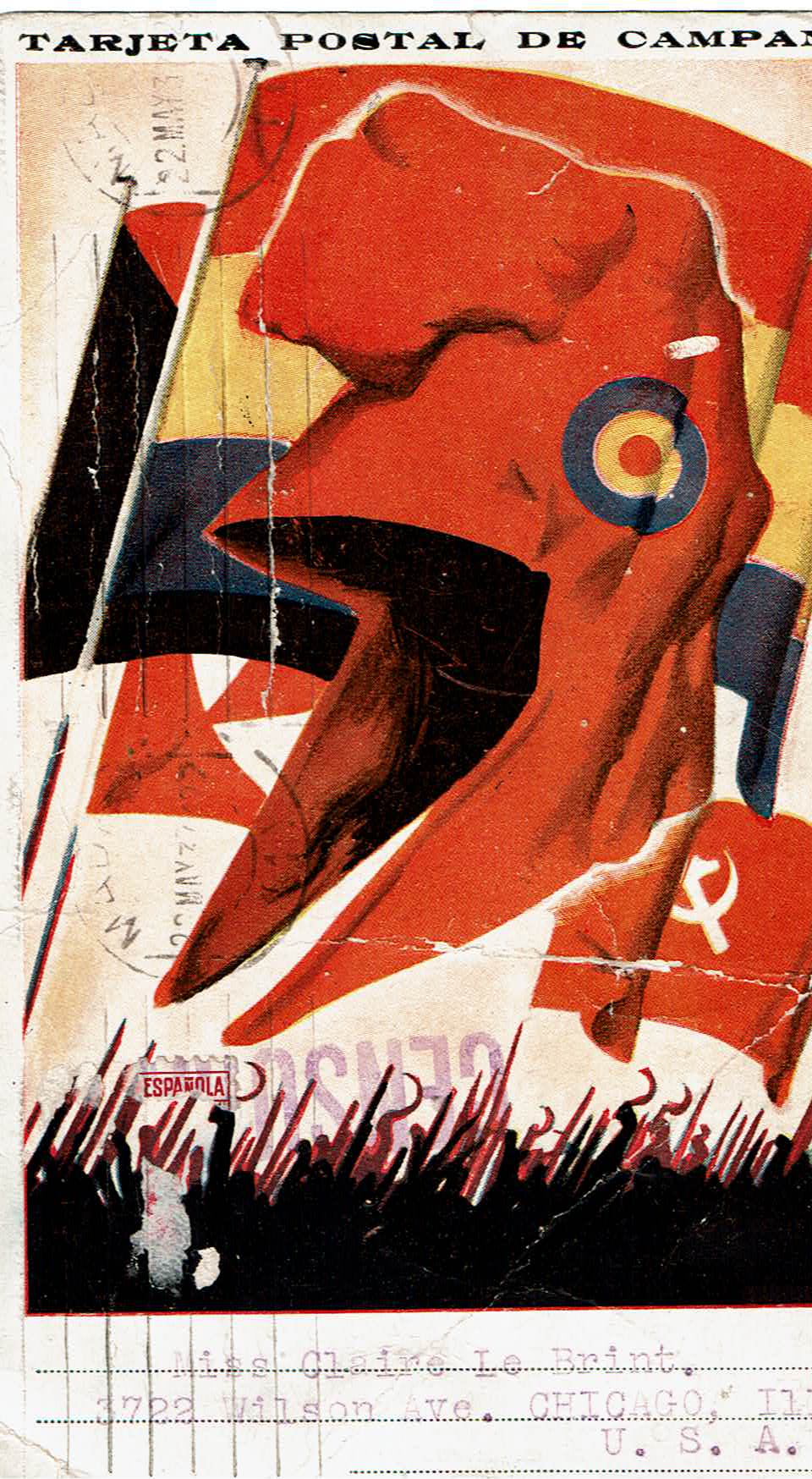
 Then one fateful day in 1937, a postcard arrived. Today, many years later, I I'm looking at the postcard dated May 1937. 


When I see its provocative drawing of a red hood (which looks a lot like a white KKK hood) plus a flag displaying the Communist Hammer and Sickle, the encounter between me and Ma comes back in vivid detail.

Ma and Pa were immigrants from Russia. Ma came to America in 1905, from a small town near Odessa in the Ukraine. Ma was sent here by her mother to get her away from the frequent and ferocious pogroms against the Jews. For Ma anything and anyone Russian (except Jews from Russia) was bad and dangerous to our well being. She despised the Soviet Union (which included the Ukraine) and by extension Communism. 

Pa was from the cosmopolitan city of Kishinev, Bessarabia Russia, and like many young men at the time he had been conscripted into the Tsar’s army for fifteen years of service. By 1907, Ma and her American cousins in Chicago (on her mother’s side) raised enough money to pay the required ‘”ransom” to get Pa out of the army and bring him to the U.S. This arrangement was contingent on his agreeing to marry Ma,  his first cousin (on their father’s side). Before Pa’s conscription, he had been active in one of the many Jewish Socialist organizations in Kishinev. Pa was sympathetic to Communism, and after the fall of Imperial Russia, he hoped that the Soviet Union’s noble experiment with Communism would make a better life for all who lived there.

Pa wasn’t alone in his sympathies. In the 1920’s and 1930’s there was a strong Socialist movement in the U.S. and a smaller but devoted membership in CPUSA (Communist Party USA). Also, some Americans, including my sister Rose and her husband Len, supported the Republicans (“Reds”) during the Spanish Civil War. Support for Socialism and Communism all but disappeared in the U.S. when the world learned of Stalin’s ruthless totalitarian rule and when the Red-scare perpetrated by McCarthy happened in the 1950s. 

 The red postcard arrived during the day while I was at work, and Ma saw it first. When I got home that evening, she was at the door waving the postcard at me, yelling, “Clara, Clara why are you making tsuris for our family by still writing to that man, that goy who I see now is a Communist and a Russian sympathizer?”

 I grabbed the postcard from Ma, excited to get something from Jesus, but like Ma I was shocked by the drawing. I knew that Trajeta Postal de Campa translated to “Campaign Postcard.” On the back of the postcard there was a pre-printed section on the top which started Condiciones Para Ganar La Guerra, “Conditions to Win the War” and ended: Del Manifesto del C.C. del Partido Comunista, “Of the Manifesto of the Central Committee of the Communist Party.” I’m sure that Ma looking at the postcard knew what Jesus was mixed up in, what with the Hammer and Sickle on the front and Manifesto! Partido Comunista! on the back.

  Ma was pacing back and forth and said in a trembling voice, “Wait til Pa comes home and we will put a stop to this thing you have with that man. You told me you were no longer writing to him and now, he writes about being a Communist. You must burn this postcard. It’s gerferlekt (dangerous) for us to have it.”

 I snuck a quick look at what Jesus wrote. His brief message contained the usual chiding and questions and reminders: “I haven’t heard from you lately… Write soon… How is your writing going? Send me something of your work…” Nothing about the war. But there was a censor’s stamp on the front of the postcard, so all he could write was pleasant innocuous things.

 Pa came home, late as usual. He worked long hours at The Central Press which was located near the Chicago Stock Exchange. During the Depression, especially after Franklin Roosevelt became president, Pa and his Swedish-American business partner LeRoy Dickenson got lots of work from stock brokers. Then as now, except at the beginning of the Depression stock brokers make out like gang-busters. I wish I had been more of a risk taker and had invested in the stock market during my lifetime. I could have made out like gang-busters too, or I could have lost my small financial nest egg. Woulda, coulda, shoulda. Water over the dam, as they say and in the 1930’s I was glad to be working, contributing to the family’s finances, with a little money left over to buy a pretty dress now and then and to pay for my evening journalism classes at Northwestern.

 Ma gave the postcard to Pa and shared her fears about Jesus, not ever calling him by his name. Pa looked at it carefully, quietly. Pa was always quiet when Ma began ranting. He was mild-mannered by nature and kept his opinions, this time about the Soviet Union and Communism, to himself.

 As always Ma’s word – along with Pa’s silent assent – was final in our house. Like Pa, I stayed quiet. But I continued to write to Jesus. Our correspondence made my life interesting and his flattery and support of my writing nourished my spirit. And I was intensely curious to learn more of his experience in the Spanish War.

 Perle, who was four years my junior, listened to Ma’s ranting from her room. Perle was quiet like Pa and often stayed out of sight. Perle was about to graduate high school and would be helping Ma around the house during the summer. She never went against Ma directly, but agreed to be my co-conspirator and intercept any additional mail from Jesus.

 One month later a second postcard arrived. Perle set it safely aside for me. 

This postcard was dated June 19, 1937 and I am surprised that what Jesus wrote about the war got past the censors.

Esteemed friend Clara: Taking advantage of a forced rest by means of an inopportune gunshot wound to my arm, I hasten to reply to your letter. I don't ask that you pardon my tardiness since you will understand the circumstances we Spaniards find ourselves in, and I do hope you will not blame me.

 You needn't be distressed for the fact that it takes me longer to respond to your letters than I would like, but given that, don't cease sending me letters which I await anxiously. As regards my being able to write to you, now I must limit myself to a brief reply as they need to use the typewriter.

 Continue sending your letters to my house [in Madrid] as that is how I have been receiving them in the past. I will always appreciate you. Jesus

I pardoned his tardiness, but was distressed about his “inopportune gunshot wound.” I have no other letters or postcards Jesus might have sent during the Spanish Civil War.

For more about Clara's pen-pal Jesus and more Clara stories, purchase the book by Betsy Fuchs: Twists and Turns There Once Was a Dream, an imagined memoir based on the life of Betsy's aunt Claire LeBrint Metzger. 

Wednesday, September 29, 2021

Rose "Fewkes," Leonard "Fooks" and me


My mother and father, of blessed memory, couldn't agree on how to pronounce their last name. It is spelled F-U-C-H-S. Mom called herself Rose Fewkes and Dad called himself Leonard Fooks. I pronounce our last name Fewkes.

One year while attending services at Beth Emet Synagogue (Evanston, IL), I announced that I was saying kaddish for my father Leonard Fooks. Bekki Kaplan, Beth Emet’s Executive Director, apologized to me, “I’m so sorry I’ve been saying your last name wrong all these years.” “Nope” I replied. “That’s how he pronounced it, so that’s how we pronounced his last name.”

My parents agreed to disagree about their last name. No problem there. But not on political issues. Dad was the rational one who could marshal arguments based on facts he got from Time Magazine and from the Chicago daily newspapers. Mom was the opposite. Not irrational rather she formed her opinions based on her heart and her life experiences. Dad vocally and angrily tried to get Mom to buy his arguments. Mom let him know that her views stood and his well-formed arguments didn’t convince her to change her way of thinking. Here’s one example of how their differences played out: Mom voted for the “senior” Mayor Richard J. Daley because he was personable, and she felt he took care of Chicagoans, like he was our benevolent uncle. Sometime during Richard J’s six terms in office, Dad ran for Alderman of Chicago’s 39th ward as an Independent candidate in opposition to Daley’s Democratic machine. (Dad lost, of course.)

What about me? I learned from listening to their different views on politics that there was validity on both sides. The senior Mayor Daley was personable and took care of us White folks in Chicago, but Daley supported policies that kept our city segregated, kept services unequal and kept patronage strong. Still… the city functioned.

For better or worse I see both sides of the political divide, even today. I know that many Trump supporters and anti-vaxxers are ill-informed about some things; you may think about all things. But they are not stupid and I would never call them “a basket of deplorables,” as Hillary Clinton did. They are our fellow citizens and I believe that many of them have been hurting financially and have been scared for a long time. I believe that like you and like me, they want to ensure that their children will succeed financially and be able to afford a car, a house, and to have children of their own.

And I contend that many Americans believe the government doesn’t have their best interests at heart. Case in point, Congressmen and women who have good insurance, good pensions, etc. etc. and large “war” chests that keep them getting re-elected. Another case in point: who in their right mind understands why our so-called great democracy has the president chosen by electors, not by the popular vote?

Ask me in person to share my political views, or expect me to join you in your strong and vehement criticism of those others and I often I keep quiet. I don't want to debate you. I have my reasons for not getting involved in the discussions of who is right and who is wrong on major issues of today. Some are rational, Some are based on my heart and life experiences. But writing safely on my blog, I can tell you that my way of thinking, seeing both sides, is still with me even though it’s shaky these days  -- what with the Covid Delta variant and especially since the Supreme Court decision on September 20, 2021 to not hear the Texas Roe v. Wade case.

Mom called herself Fewkes. Dad called himself Fooks. They were OK with that difference. But how I wish they had learned to accept each other’s views, or at least listen respectfully.

That’s what I try to do.

About the photograph of my parents: As they grew older, they lost interest in their political disagreements, and instead were in total agreement about the national and international places they wanted to visit, including to Banff National Park, Canada in 1981.

Thursday, June 10, 2021

Talking Back to Myself: How I Learned to Sail and Soar


My dad sailed with his pals on Lake Michigan in the 1930s. I have the photos to prove it. 

I inherited his love for sailing and at ten years old, I was sailing alone / on my own in a small 13-foot sail boat. My dad taught me during the summers we spent at Cross Lake just north of Antioch, Illinois. He was a good teacher and the lake was little, but always he or my mom would be on the shore watching out for me.  I loved being on my own on the water, gliding along quietly, sailing and soaring with the wind.

 After I graduated college, at the age of twenty-two, I defied my parent and went solo to San Frsancisco to live and work, most likely inspired by the song California Dreaming – that was all I knew about that beautiful city. While there I sailed on Lake Merced in a one person Sunfish and also sailed a few times on the San Francisco Bay with a youth hostel group. At the end of one year, I returned to Chicago to find a mate, get married and become a responsible adult.

 Soon enough I married a fellow Chicagoan and we settled down. Now and then I’d meet someone who had been sailing on Lake Michigan, but in a strident internal voice, I told myself, Your time for solo adventures is over, and added apologetically, Sorry. You can’t go sailing.  I never questioned the voice. I wanted to be a “good wife,” in the best early 1970s sense: putting my husband’s wants and needs first, internalizing his unspoken message “You can’t go off on a solo adventure; it is would put our marriage in jeopardy.”

The marriage didn’t last and in the 1980’s I fell in love with a woman. We would have married if it had been legal. Still I wanted to be a good partner to Katy, wanted to please and support her, and my inner voice continued to warn me not to go on solo adventures.  Except once when against her expressed displeasure, I got up at the ungodly hour of 5am to take Tai Chi classes at the lake. My little assertion of independence felt like rebellion. You might be asking: wasn’t I already a feminist and rebellious, living with my ladylove? Bravery takes many forms and it took all the courage I could muster to take the classes, going against what I perceived as Katy's wishes. 

Katy and I were no longer together when I found information about Brooke Medicine Eagle’s “Singing the Sacred” camps in Montana. Attendance at the camps promised excitement, enchantment, a real adventure. Still my inner voice said, No. You can’t go. This time I talked back, Yes you can. You can go to this camp, on your own / alone. Remember, you did things like this years ago and you can do it now.

Twenty-two women attended the camp. We slept in tents and each day we were awakened by a camper who drummed outside our tents and sang:

Waken, Oh awaken, from your dreaming, birds are singing in the tree-tops…

Waken, Oh awaken, something’s coming, something beautiful for you…”

Our days were beautiful, full of singing and chanting, while we walked to our meals, when we were outside, on rainy days sitting in a circle in a Yurt, and once in a deep dark cave where our songs echoed against the walls and ceiling.  Sometimes we would sit in the tall grass and drum and sing for hours. In this photo I'm on the far right, playing on a big drum, with a short hair and sun glasses. Other times Brooke would share Native American teachings with us. 

Before camp ended, Brooke gave each of us a name to reflect our new selves. Mine was “Soars with the Drum Call.” Brook explained that I could “soar” beyond my life as it had been and the drum call would remind me to listen to my own heartbeat, to my own true self.

The name might have been inspired by our horseback riding experience. I had shared with the group my life-long fear of horses which went back to a summer at Cross Lake. I was nine or ten years old, small and short for my age. I had been lifted onto the back of a horse which seemed very high up and very scary. Right away, I asked to be taken off. My friends spent the afternoon horseback riding, while I waited in the car.  My camp sisters encouraged me to get back on the horse. I was still short and small; the horse was big and most likely someone had to help me get on up on the horse. I was uncomfortable in the saddle but it was lots of fun.

I got back on a horse in Montana. It was time to get back in a sailboat in Chicago. This time my inner voice said joyfully, Yes you can. You can go sailing.

I signed up for lessons at Burnham Harbor, just south of downtown Chicago. We would learn to crew with others, sailing on a 25/30 foot boat. Signing up for the lessons was easy. Getting to the lessons was hard. My inner self was freaking out, How will I find Burnham Harbor? Where will I park when I get there? I’ll get lost and be late and they will sail without me. I left home early, found the harbor easily in plenty of time for our first on-shore class.  I continued to freak out, worrying, Will I ever learn what to call things on the boat?  Will I be able to tie the knots?  I can’t tell which way the wind is blowing.  Will I be kicked out of class? I’m 55 years old and stupid compared to the youngsters in my class.

 I hadn’t even gotten on the boat yet! 

Over the course of the eight-week class, I learned some of sailing terms. I never learned how to tie knots and was never able to identify which way the wind was blowing but they let me on the boat anyway. The teachers were at once patient and impatient and never kicked me off the boats. And I learned to sail! Actually what I learned was to be part of the crew.

The next summer, I took more sailing lessons and got a little better at crewing and took part in some evening races on Lake Michigan.  We never won a race, but it didn’t matter. We sailed at sunset; all the boats had colorful spinnaker sails ballooning out, catching the wind, sparkling in the late afternoon golden sunlight. We were sailing. Soaring. I was in heaven! Later that same summer, I took private lessons on a Sunfish in Wilmette Harbor. During my fourth lesson, I sailed by myself, with the instructor nearby. But I was alone / on my own. Loving it!

I stopped sailing because of health problems, but kept soaring. In 2001 I went on my first trip out of the country by myself, to a Yoga retreat in Cancun, Mexico.  While there, I wrote in my journal: “Action starts with bravery. Bravery for me at this time is traveling to a new country by myself.  I’m scared but I do it.”

I'm 77 years old now. And my heart beats steadily for which I am most grateful. And my inner voice still speaks to me, these days softly and graciously saying, At your age it's perfectly ok to stroll along the lake  front with friends and enjoy watching the sail boats. 

Sunday, August 9, 2020

Twists and Turns: Early Memories of My Siblings (excerpt from book)


In the early decades of the twentieth century, some professional photographers traveled the neighborhoods, bringing ponies to fancy up the pictures. Families paid extra to show off the kids on and around the pony. “What a photo to send back to the family in the old country,” my mother would say, adding “Won’t they be impressed!”

After our family got a Kodak camera in 1924, we took our own photos, at home, at Lake Michigan, anywhere and everywhere. But before then on a few rare occasions, we had formal photographs taken by a professional photographer. In one, I’m sitting happily on a pony with a tooth gapped-grin on my face, wearing a long-sleeved slightly oversized white dress with a peter pan collar.


In front of me and the pony, my older brother George stands, wearing a white shirt, dark colored knickers and athletic shoes. Next to George are my “twin” older sisters Mary and Rose. They weren’t twins, but that’s what I called them. They were one year and a few months apart in age and different in stature and looks, but like twins they lived in their own shared world, to the exclusion of everyone else, especially me. The photo isn’t dated but I would guess I was 3 1/2, George 5, Rose, 6 1/2 and Mary 8. The twins are both in white knee length dresses, with white stockings and they are holding hands.  Around the same time, the twins, at the insistence of our fully Americanized same-age cousins, learned how to stop speaking English in a Yiddish sing-song kind of way. And the cousins taught them how to dress properly for school, in bright white starched and ironed blouses, clean pressed skirts, with their shoes polished daily. 

In another professional photograph, taken before I was born, a very young Rose and Mary stand side by side. Rose has a serious look on her face; Mary’s is more quizzical. Rose is fair skinned favoring Father’s coloring and has a chubby baby face and fat arms. Mary who is a bit taller than Rose is swarthy, taking after Mother and if once she had baby fat, it’s gone. They are wearing not-quite-matching white dresses that hang almost to their ankles and large white bows in their hair. Most likely these dresses, and the ones we girls are wearing a few years later in the pony picture, were bought to last through growth spurts and were saved to wear only on special occasions. Mary and Rose have almost identical brown leather high-top shoes and are holding little porcelain dolls, also dressed in white. Just like the pony, these dolls must have belonged to the photographer. At home all we had were Raggedy Ann and Andy dolls that Mother made out of old flour sacks.

The twins got to hold the dolls. I got to sit on the pony. Lucky me! Or maybe lucky them because in 1921 Mary and Rose had a second professional photograph taken of the two of them, dressed like twins in matching outfits, looking self-assured and a bit smug, especially Rose with her head cocked to the side.

Neither George or I, nor three-year-old Perle had our pictures taken professionally in 1921.

The twins had each other and I had George, who allowed me to tag along as soon as I could toddle after him. And shortly after George went to full-day school at age six in 1918, I had baby Perle who was born a few months later. From then on until I went to full-time school in 1920, I had Perle to play with. When she was a baby, Mother let me feed her and dress her and rock her and when she got a bit older, Perle toddled around after me.  Perle was so much better than a borrowed porcelain doll or the home-made Raggedy Ann and Andy dolls.

So, in our family among the siblings, Mary and Rose made a twosome. And for a time there was me and George, then there was me and Perle.

Thinking back to this sibling configuration, I realize this is how we stayed into our adult lives. Mary and Rose together, the married women with husbands and children. George the only boy making his way on his own. And me and Perle, the two unmarried spinsters palling around, that is until 1965 when Perle tragically died too young at age 47 and 1967 when I finally married for the first and only time at the ripe-old-age of 53. 

For more Clara stories, purchase the book by Betsy Fuchs: Twists and Turns There Once Was a Dream, an imagined memoir based on the life of Betsy's aunt Claire LeBrint Metzger. 


Thursday, July 9, 2020

The Spaciousness of Books (in the time of Covid)

Twenty-first century clutter traps me
fills my time and in a daze my days disappear
What with Facebook and Messenger and FaceTime, Twitter Email YouTube Wikipedia Blogs Podcasts Texting Internet Research and now due to Covid Zoom Gatherings and Facebook Events 
Twentieth century paper clutter is still around still abounds 
mail delivered daily: donation pleas, advertising come-ons
-- tossed out
magazines mailed monthly: AARP, Consumer Reports and more
-- kept in baskets
handouts printouts notes from classes, events, workshops, all on Zoom!
-- kept in files and piles (like my emails, maybe to read or to need later)


Yet in my house there are books
  on shelves
    on tables
      on night-stands

many old 
a few new

some purchased
-- before my library re-opened

now thankfully some from my library

some from friends
 -- cautiously carefully borrowed


Books with their solid feel
and their sometimes temporary status
I read them now
(unlike my Kindle long gone, its electronic books unread)


Books in the twenty-first century are
unique      a treat      rare

and when I curl up in a chair
  and hold a book
    and feel the paper
      and turn its pages

when I read and reread and mark parts I love
  with sticky notes or paperclips or highlighting
      or when I underline

my life is spacious and slow

in the old-fashioned twentieth century way


This poem published November 2018 at https://www.poetsandpatrons.net/
Revised Summer 2020 to reflect changes brought on by the Covid Sequester


Sunday, October 20, 2019

Clara's Stories: 1930-1941 Jesus Pena de Alonso


I find fifteen letters and two postcards from Jesus Pena de Alonso of Madrid, Spain. Jesus and I were matched up by our foreign language teachers when Jesus was fifteen and I was seventeen.  Jesus’ first letter is dated November 5, 1930, the last March 11, 1941. He wrote in Spanish and I replied in English. We continued to write on and off after we both completed secondary school. For eleven years!

I don’t remember my Spanish anymore so I had my good friend and neighbor Alex Alvarez, a Spanish speaker and an avid student of history, translate Jesus’ letters into English. Alex told me some about the tumultuous history of Spain in the 1930’s and acted as a consultant to me while I wrote this story. Thank you Alex.

Just like in the U.S. a lot was going on in our two countries during the time Jesus and I corresponded. Of course, lots was going on in our young lives. It makes my head spin just thinking about it. 

In the U.S, we had the depression and FDR and the New Deal and the beginning of World War II. And I became a working girl, more interested in having adventures and pursuing creative endeavors than in getting married. In Spain, political unrest led up to the Spanish Civil War (1936-1939). Jesus attended University and then went to work in his father’s factory. He must have witnessed much of the war, since many of the battles took place in Madrid (the capital of Spain) and the surrounding areas. Jesus didn’t write during the war, and after our correspondence resumed, he mentioned the war only briefly. Who can blame him?

Looking at Jesus’ letters (and envelopes) today, I am struck by his beautiful script.


In his letters, Jesus addressed me as Clara, my birth name. I liked that.

For the first couple of years, Jesus’ letters were friendly and informative. I don’t have copies of my letters to him, but I can infer some of what I wrote in his letters to me. We wrote about our interests – his in football (soccer), swimming, and travel; mine in writing, journalism, and theater. He wrote me about “an ancient royal castle … converted into a museum” and sent me postcards of the beautiful salons in the castle. I wrote about the much younger skyscrapers in Chicago and sent him a postcard of the thirty-four story Tribune Tower. Today thirty-four stories seems like nothing, but in the 1930’s the new skyscrapers were amazing, tall, architectural marvels.

In 1932, I sent Jesus U.S. currency and he attempted to send me Spanish currency but couldn’t.

Dear Clara,
I had written a letter to you, but because I had sent along some currency, the Central Post office refused to mail it.

Alex explained that during the early 1930’s the Spanish government forbade sending currency out of the country due to the on-going political crises.

Jesus’ letters continued along this same line, breezy and conversational, until 1934 when we exchanged photographs. His was a studio portrait and I liked how he looked with his half smile, bedroom eyes (or so I perceived them), slicked down hair, and beautifully tailored suit. I was mildly charmed by the inscription that read (in translation) “To Clara as a token of my admiration and fondness Jesus.”

However, Jesus was majorly charmed after he received my publicity photograph taken for an amateur production of the play Death Takes a Holiday, in which I had the lead role of Graziela.

Claire LeBrint Publicity Photo 1934

From that point on his letters became romantic.

From October 1934

Beautiful Clara,
I don't know how you dare to call me a flatterer after sending me a photograph so superior to anything I may have imagined. Truly, the more I look at your photo, the more difficult it is for me to believe that you are an American woman, as the beauty of your eyes is not surpassed by the Grenadine dolls.

The letter continued with a brief reference to the trouble in Spain “…the police have been using my car, they have even requisitioned many automobiles,” and ended with more affection and devotion towards me.

Furthermore, dear friend, I continue to maintain much serenity, as I have never had the joy of having at my side someone as precious as you. My most respectful tribute, Jesus                

Being compared to a Grenadine doll (from Grenada, Andalusia Spain) seemed a high compliment. Alex found a picture of a 1950’s Spanish doll and made a Xerox color copy for me. Color copying – what a marvel of technology. We both agreed that this must look something like the “Grenadine doll” Jesus referenced. What a compliment Jesus gave me!


Little did I know that Jesus’ romantic feelings would grow into an obsession and possessiveness toward me.
From February 1935
. . . I have a sister who was also taken with the idea of becoming a writer like you and who now has abandoned those ideas because she is soon to be married. Has the thought occurred to you of doing the same?

As you have asked me to advise you in the past, I hope you will allow me to advise you now not to leave the house, so you will find no diversions, you will speak to no one, you will be dressed in your oldest dresses. And if you will be following these suggestions, I believe that when the time comes, you will be spared the inconvenience of marrying the man who would have to murder your husband.

I knew that Jesus’ letters indicated he was “crazy-in-love” with me. But did he really imply that I should stay home, alone, away from all guys and that if I should happen to marry, he would come to the U.S., murder my husband and expect me to marry him? I thought Alex had gotten the translation wrong. “It’s right for sure,” he told me and added, “I even had a Spanish teacher friend of mine from Sauk Valley Community College double check my translation and she confirmed I got the crazy-talk right.”

You might be asking yourself why I continued writing to Jesus.

I was having fun doing some heavy-duty flirting in my letters to him, goading him on, encouraging his growing attachment to me. We girls did that kind of thing, and my girlfriends loved to read his crazy letters. It was our own personal soap opera and I loved being the romantic lead.
Besides, Jesus was far away, as he wrote in another letter when he was again pondering whether I was married or not, “If it happens that you now have a husband, tell him that he lives because of the distance between Madrid and Chicago.” 

There is so much in Jesus’ fifteen letters, and I was getting tired from reading them and thinking back to when I received the letters. But before I put them away, I decided to skim through the rest and a few sections of letters jumped out. First was the letter Jesus wrote after the Spanish Civil War ended.

From September 1939
. . . I am sure you can easily understand the many circumstances which have prevented my writing to you during these trying times.

And then I found the only letter where Jesus referred to experiencing the war, where he used the war as a reason to threaten my male friends. In my letters to him after the war ended, I must have casually mentioned the guys I was seeing (not seriously) and continued teasing him, flirting with him. No harm done, I thought. Not so for Jesus.

From June 1940
. . . As to those two boyfriends . . . after three years of being witness to war and guns and shooting and killings, they would not pose the same obstacles as was the case previously.

That letter frightened and shocked me when I received it in 1940, as it does to this day. His threats were no longer funny. The amusing soap opera had become a horror story.
It took me a long time to reply to that letter, as Jesus wrote in March 1941, when he chided me that he “was not able to read (my) last two letters because (I) didn’t mail them.”  True I wrote several letters that I tore up and I have no idea what was in the letter I finally sent.
But I finally was done with Jesus and wrote him one last letter. I remember that my message was short and to the point and it went something like this.

Jesus,
It is not acceptable that you continue to make threats against my gentlemen friends. You have no right to claim me. You are not my boyfriend, fiancé, nor will you ever be my husband.

This correspondence is over. Please do not write me anymore.

Claire LeBrint

Jesus Pena de Alonso of Madrid, Spain must have gotten my message loud and clear. He wrote no more letters and you better believe I was relieved.

But, as they say, it was fun while it lasted.

For more about Jesus and Clara's letters and more Clara stories, purchase the book by Betsy Fuchs: Twists and Turns There Once Was a Dream, an imagined memoir based on the life of Betsy's aunt Claire LeBrint Metzger.